
Wall thickness
Sink marks, warpage and short shots traced back to nominal wall and rib-to-wall ratios, with concrete numbers for your resin.
Capabilities
Six capabilities that cover the entire path from your 3D data to packed parts: mold design and DFM, precision machining, tool manufacture, over-molding, threaded-part tooling and 20T–300T production molding. All of it happens inside our 2,520 m² plant in Humen, Dongguan — nothing is subcontracted.
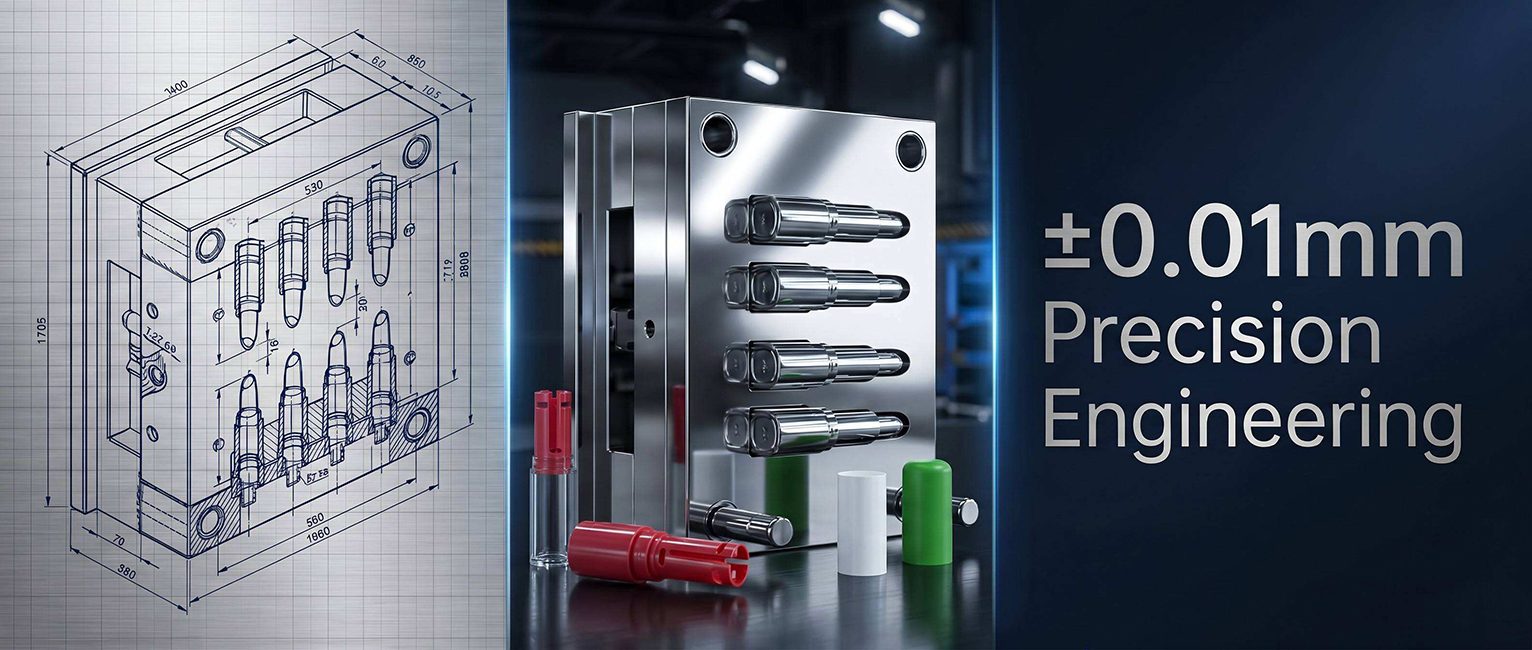
CENTS Precision Manufacturing is a custom injection mold manufacturer in Dongguan, China, building tools from single-cavity prototype molds to 64-cavity production molds, and running those molds in-house on 30 presses from 20T to 300T. We work in P20, 718H, NAK80, S136 and hardened steels, hold mold work to ±0.01 mm, and provide a DFM report with every quotation. Tool ownership always stays with the customer.
Service 01
Mold construction is our core trade. We have designed and built plastic injection molds since 2003, for cosmetics packaging, medical devices, toys, mechanical parts, consumer goods and electronics.
Every tool starts as a design review of your part, not as a machining order. We decide the parting line, cavity count and layout, gating, cooling circuit, ejection strategy, slider or unscrewing requirement and steel grade together with you, then cut steel only after you approve the design.
Steel choice is a life-cycle decision, not a price decision. We will tell you where a cheaper grade is genuinely fine and where it will cost you a mold rebuild later.
| Grade | Hardness | Typical life | Best used for |
|---|---|---|---|
| P20 / 1.2311 | ~30 HRC | up to ~300k shots | Prototype and bridge tools, low-volume parts, cost-critical projects |
| 718H / 1.2738 | ~33–36 HRC | 300k–1M shots | General production molds, large plates, household and mechanical parts |
| NAK80 | ~40 HRC | 500k–1M shots | Mirror-polished cosmetic surfaces, lens and packaging parts |
| S136 / 1.2083 | 48–52 HRC | 1M+ shots | Corrosive resins (PVC, flame-retardant, medical grades) and high-volume tools |
| Hardened H13 / SKD61 cores | 48–52 HRC | 1M+ shots | High-wear slides, cores and long-run engineering parts |
Shot-life figures are typical industry expectations for the grade, not a warranty: actual life depends on resin, abrasive fillers, cycle and maintenance. We confirm the grade with you on the mold design approval sheet.
Service 02
A design change costs nothing on screen and a fortune in hardened steel. We run design-for-manufacture analysis before quoting, not after a failed trial.
Sink marks, warpage and short shots traced back to nominal wall and rib-to-wall ratios, with concrete numbers for your resin.
Draft on every surface that leaves the steel, and a decision on sliders, lifters or split cavities where undercuts are real.
Gate location and size versus weld lines, cosmetic surfaces and cycle time; hot runner versus cold runner trade-off.
Resin-specific shrinkage applied to steel dimensions, plus a realistic tolerance review of what the tool can hold.
What you receive with the quotation: a written DFM opinion listing the risks we see (in order of severity), a cavity layout sketch, a mold price, a molded-part price and a lead-time commitment. If a part is not moldable as drawn, we say so before you commit money.
Service 03
Mold parts move from cutting to EDM to polishing inside the same building. That removes transport queues from the schedule and keeps one team accountable for the fit.
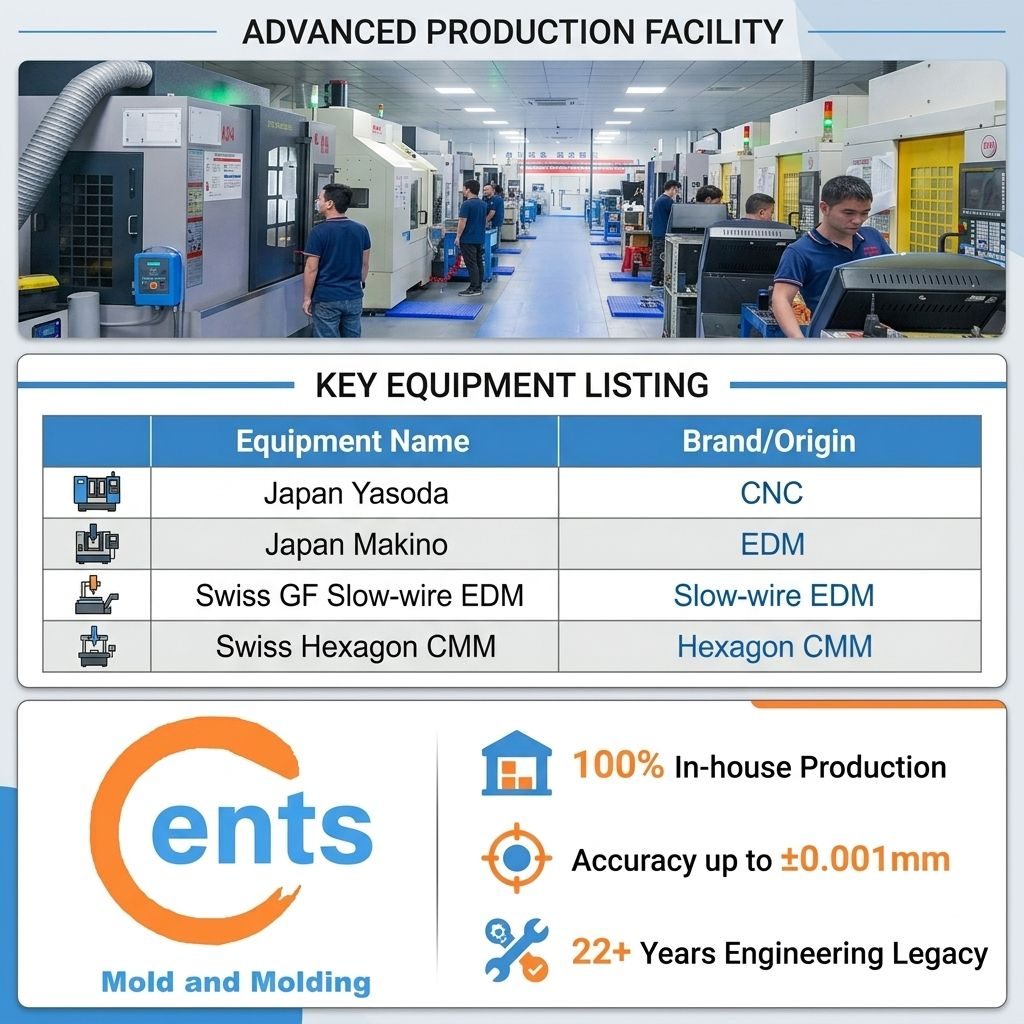
Japan Yasoda YBM640V, Japan OKUMA MP46V, Taiwan Yongjin NSV1020MA/NDV850, Japan FANUC D14MIA and Koruisi 540A centres — from 0.001 mm to 0.005 mm positional accuracy, running through the night on automated cycles.
Swiss GF E350 wire-cut machines at 0.001 mm accuracy for cores, cavities, ejector plates, shut-offs and hardened inserts — the surfaces that decide whether a mold seals on the first trial.
Japan Makino EDG3 sinkers for deep ribs, sharp internal corners, textured cavities and hard-steel detail that a cutter cannot reach.
Shenyang millers and Jiande surface grinders for plate preparation, parallelism, flatness and the fits between cavity, core, slides and ejector systems.
Hand polishing to SPI A1–A3 for optical and cosmetic parts, plus bead blasting, matt and leather-grain texturing for packaging and consumer products.
Swiss Hexagon 860 CMM at 0.001 mm accuracy, plus a Zeiss Contura machine in our inspection centre, so mold geometry is measured rather than assumed.
Service 04
Trial, bridge and series production in the same building as the tool shop, so a mold problem is a tool-shop problem the same day — not a support ticket.
Our molding workshop is served by 30 injection molding machines between 20 and 300 tonnes, which covers parts from a few grams up to large moldings, depending on wall thickness and geometry. Alongside the presses we run an anti-dust molding area, in-house material handling and drying, and an assembly area for snap-fit, ultrasonic welding and packaging.
Mold work is held to ±0.01 mm. On molded parts, what you can actually hold depends on resin, wall, size and cavity count — typically ±0.05 mm on critical dimensions of a well-designed part, and tighter on dimension-critical features at ±0.02 mm. We will tell you which of your dimensions are realistic before you design around them.
Service 05
Multi-material parts fail for one of two reasons: the bonding geometry was never engineered, or the second-shot tool was made by someone who never saw the first one. We build both tools as one system.
A soft-touch TPE/TPU skin molded directly onto a rigid substrate — grips, seals, buttons, gaskets and anti-slip surfaces. Mechanical interlocks and wall thickness are designed together with the adhesion requirement in mind.
Metal threads, pins, bushings, magnets or terminals encapsulated in plastic, removing assembly steps and improving positional strength in the finished part.
Hard-soft combinations, two-colour cosmetic parts and parts with an elastomer seal molded in the same tooling family, using a rotating platen or a transfer sequence on our presses.
Engineering note: over-molding adhesion depends on material pair, melt temperature at the interface, substrate surface and wall build-up. Send both materials with the 3D data and we will confirm the pair and the wall before design approval.
Service 06
Caps, closures, cosmetic tubes, bottle necks and any part with an internal or external thread — tooled without dragging a parting line across the thread.
We have been building threaded and cosmetic tube tooling for the cosmetics industry for more than 15 years, including lipstick tubes and inner tubes for a well-known European brand. Those tools were specified for a 1,000,000-shot life requirement; the versions we built have been validated at 5,000,000 shots. If your part has a thread, a rotating core or a cosmetic surface, that experience is directly reusable.
Unscrewing adds cycle time but keeps the thread flawless; collapsible cores are faster but limited in thread depth and pitch. We quote both variants when the part allows it, so you can choose on data rather than on habit.
Yes, on internal threads: an unscrewing or collapsible core leaves a clean circular thread. On external threads a split is usually visible on the parting side unless the thread is molded with a rotating cavity.
Unscrewing tools are commonly built in 1, 2, 4 or 8 cavities; collapsible cores scale further. Cavity count is decided by press tonnage, cycle time and your annual volume — we propose the layout with the quotation.
Geared unscrewing units and collapsible cores are specified as standard components from recognised suppliers; the mold plates, cores, cavities and the motion design are made by us in-house.
Materials
If your resin is not on this list, ask anyway — most engineering grades run perfectly well on our presses 20T to 300T.
PP, PE (HDPE/LDPE), PS, HIPS, ABS, PVC (with correct steel selection), SAN, AS.
PC, PC/ABS, PA6/PA66 (with and without glass fill), POM, PBT, PET, PMMA, ASA, TPU.
PPS, PSU/PPSU, PEI, PA+GF30/GF50, LCP, PEEK grade parts where tool temperatures allow.
TPE/TPU shore-adjusted grades for over-molding, SEBS compounds and soft-touch cosmetic grades.
Limitations we are honest about (F6): CENTS does not offer die casting, blow molding, extrusion, thermoforming or metal stamping, and we do not run presses above 300 tonnes. If your project needs one of those processes, we will say so at the first message rather than quote around it.